A technician begins repairing a conveyor belt without disconnecting the power. Seconds later, a coworker restarts the system remotely. The result: catastrophic injury. This scenario isn’t hypothetical—it’s a preventable tragedy that has played out too many times in industrial environments. The lockout tagout (LOTO) procedure exists to stop exactly this kind of incident.
At its core, the lockout tagout procedure is a safety protocol used to ensure that dangerous machines and energy sources are properly shut off and isolated from power before maintenance or servicing begins. It combines physical locks and visible warning tags to prevent accidental energization. But it’s far more than just attaching a lock and a label—it’s a structured system that protects lives and keeps facilities compliant with safety regulations.
Understanding what the lockout tagout procedure entails isn’t just a box to check for compliance. It’s a critical operational skill that every technician, supervisor, and safety officer must master.
The Purpose of Lockout Tagout: More Than Just a Safety Rule
The primary goal of LOTO is to control hazardous energy. This includes electrical, mechanical, hydraulic, pneumatic, chemical, thermal, or any other form of energy that can cause harm when unexpectedly released.
Imagine servicing a hydraulic press. Even after turning it off, residual pressure in the lines can cause sudden movement. Without proper lockout procedures, that energy remains a threat. LOTO eliminates this risk by ensuring all energy sources are isolated and cannot be reactivated during servicing.
Beyond injury prevention, LOTO serves several vital functions:
- Protects workers during repair, cleaning, or setup tasks
- Reduces downtime caused by preventable accidents
- Ensures regulatory compliance, particularly with OSHA standards in the U.S.
- Creates accountability through documented procedures and authorized personnel
In high-risk industries—manufacturing, chemical processing, utilities, construction—LOTO isn’t optional. It’s a fundamental part of daily operations.
How the Lockout Tagout Procedure Works: A Step-by-Step Breakdown
The effectiveness of LOTO lies in its structure. OSHA outlines a clear sequence of steps that must be followed every time. Deviating from this process—even slightly—increases risk.
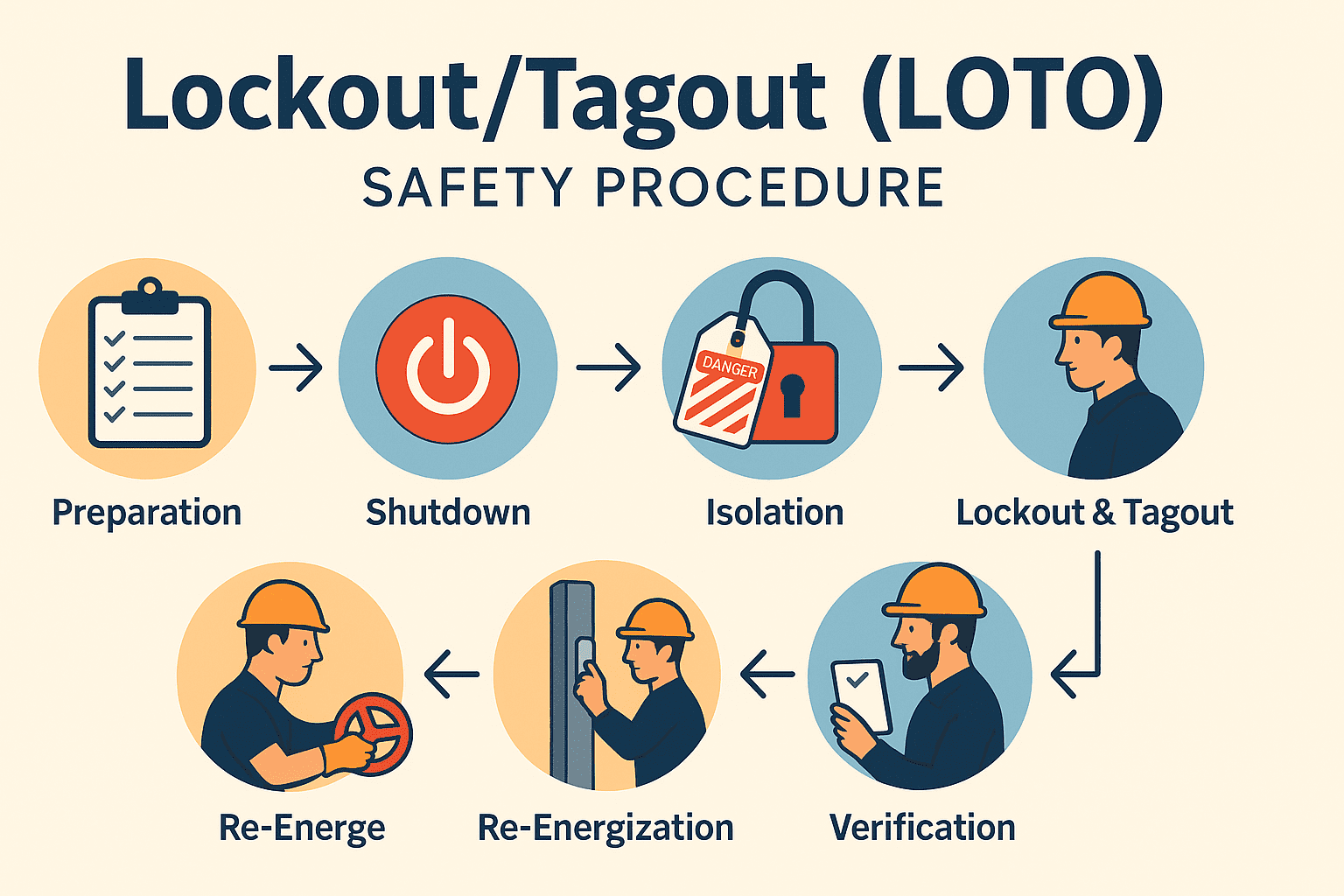
Here’s the standard procedure, adapted from OSHA 29 CFR 1910.147:
1. Preparation: Identify the Energy Source
Before shutting anything down, the authorized employee must know exactly what energy sources power the equipment. This includes main power, backups, capacitors, springs, or stored pressure.
Example: A packaging machine may run on electricity but also use compressed air for actuators. Both must be isolated.
2. Notification: Alert Affected Personnel Workers who operate or rely on the equipment must be informed that maintenance is starting. This prevents someone from unknowingly trying to restart the machine.
3. Shutdown: Power Down the Equipment Properly Use the normal stopping procedure—don’t rely on emergency stops as isolation methods. Follow manufacturer guidelines for safe shutdown.
4. Isolation: Disconnect All Energy Sources Physically disconnect power at the source—circuit breakers, disconnect switches, valve closures. This is where control is truly established.
5. Application of Locks and Tags Each authorized worker applies their own personal lock and tag to every energy-isolating device. The lock prevents re-energizing; the tag explains why it’s locked, who locked it, and when.
Critical rule: One person, one lock, one key. Shared locks defeat the purpose.
6. Release Stored Energy Even after isolation, residual energy may remain. Bleed lines, block moving parts, ground circuits, or let capacitors discharge safely.
Common mistake: Skipping this step on a machine that “looks dead.” Hydraulic systems are especially deceptive.
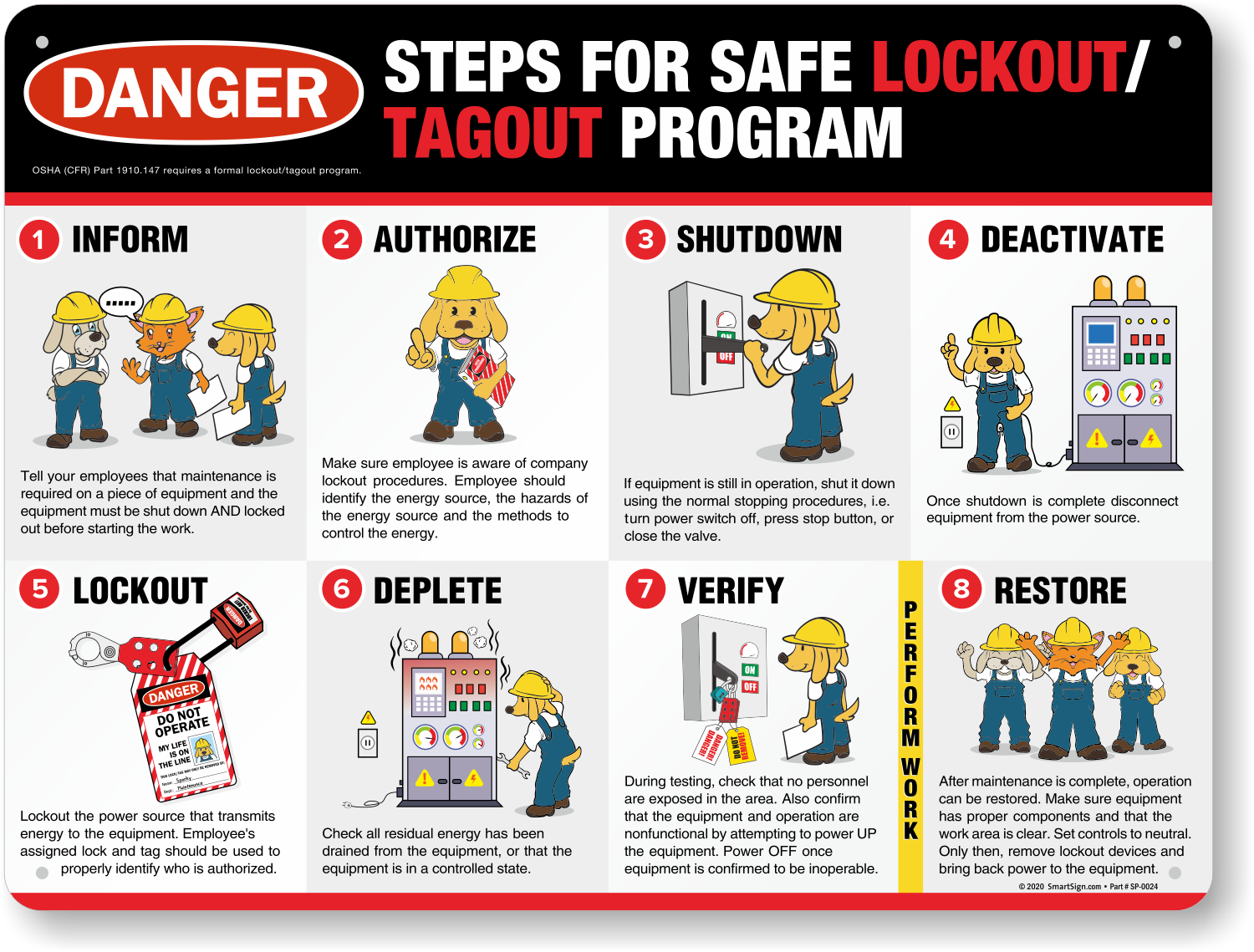
7. Verification: Confirm Zero Energy State
Before any work begins, test the equipment. Try to start it using the normal controls—nothing should happen. This proves the machine is truly de-energized.
If the machine activates, the LOTO process failed. Start over.
8. Perform Maintenance Only after all previous steps are complete should servicing begin.
9. Restoration: Remove Locks and Re-energize Once work is done:
- Ensure tools are removed
- Verify the area is clear
- Notify all affected workers
- Remove locks only by the person who applied them
- Re-energize systematically
This sequence isn’t optional. It’s the backbone of safe maintenance.
Real-World Applications: Where LOTO Saves Lives
LOTO isn’t theoretical. It’s applied daily in environments where failure means injury or death.
Manufacturing Plant: Conveyor System Repair A technician needs to replace a worn roller. Without LOTO, a coworker might restart the line during the repair. With LOTO, the motor disconnect is locked, the tag states “Repair in progress – John Doe,” and the system can’t be restarted until the work is done.
Chemical Processing Facility: Pump Servicing A pump handling corrosive fluid requires maintenance. The energy sources? Electrical power and pressurized lines. LOTO requires shutting off the power, closing and locking the inlet and outlet valves, draining the line, and tagging all points. One missed valve could lead to a chemical release.
Food Processing Plant: Auger Cleaning
After a production run, an auger must be cleaned to prevent contamination. Residual material can bind the system. If the auger turns while someone is clearing it, the result is severe. LOTO ensures the drive motor is locked out and verified dead before entry.
These aren’t edge cases. They’re routine scenarios where LOTO prevents disaster.
Common LOTO Mistakes That Undermine Safety
Even with procedures in place, lapses occur—and they’re often subtle.
Using Tags Without Locks Tagout alone is not sufficient unless the tag provides the same level of protection as a lock. Tags can be removed; locks physically prevent access.
Group Lockout Confusion In team maintenance, multiple workers are involved. A common error is using a single lock or a master key. Instead, each worker should apply their own lock to a group lockout device (like a hasp), ensuring no one can remove another’s lock.
Skipping Verification Assuming the machine is off without testing it is a deadly shortcut. Verification is non-negotiable.
Incomplete Energy Source Identification Failing to identify all energy sources—like a backup battery or spring tension—leaves hazards uncontrolled.
Poor Tag Information Tags that lack details like name, date, reason, or expected completion time reduce accountability and increase confusion.
These mistakes don’t just violate OSHA rules—they create real danger.
Equipment and Tools Used in LOTO
Effective lockout tagout relies on the right tools. These aren’t optional accessories—they’re essential for enforcing protocol.
| Tool | Purpose |
|---|---|
| Lockout Hasps | Allow multiple locks to be applied to a single isolation point |
| Valve Lockouts | Prevent valves from being opened during maintenance |
| Circuit Breaker Locks | Secure electrical disconnects |
| Padlocks (Safety-Specific) | Personal locks, often color-coded or keyed differently |
| Tagout Tags | Durable, tamper-resistant labels with space for critical info |
| Cable Locks | For isolating multiple switches or large disconnects |
| Lockout Stations | Centralized storage for locks, tags, and procedures |
Many facilities use LOTO kits tailored to specific machines. These include all necessary devices pre-packed, reducing preparation time and errors.
Who Is Responsible for LOTO?
LOTO defines two key roles:
- Authorized Employee: The person trained to implement the LOTO procedure. They apply locks, verify shutdown, and perform maintenance.
- Affected Employee: The operator who uses the equipment but doesn’t service it. They must understand the procedure and never attempt to remove a lock or bypass a tag.
Supervisors are responsible for ensuring training, auditing procedures, and maintaining written LOTO plans for every machine.
Training isn’t a one-time event. OSHA requires refresher training at least annually, or whenever procedures change or incidents occur.
Limitations and Challenges of LOTO
While LOTO is highly effective, it’s not foolproof.
- Human error remains the biggest risk. Fatigue, time pressure, or complacency can lead to skipped steps.
- Complex machinery with multiple energy sources increases the chance of missing an isolation point.
- Shift changes create handoff risks. A lock applied at the end of one shift must be respected by the next.
- Temporary tasks—like clearing a jam—may be seen as “too quick” for full LOTO, but that’s when accidents happen.
Some facilities are exploring smart lockout systems that integrate digital checklists, RFID tags, and mobile verification to reduce errors. While promising, these tools don’t replace training—they support it.
Best Practices for a Reliable LOTO Program
A strong LOTO program goes beyond compliance. It’s embedded in the culture.
- Develop machine-specific procedures for every piece of equipment—no generic checklists.
- Conduct regular audits—walk through actual lockout scenarios to test adherence.
- Use visual aids like diagrams showing isolation points and lock locations.
- Empower workers to stop work if LOTO isn’t properly applied.
- Review incidents—even near misses—to improve procedures.
One plant reduced maintenance-related injuries by 70% in two years simply by standardizing LOTO documentation and adding verification steps.
Final Thoughts: LOTO Is a Discipline, Not a Task
The lockout tagout procedure isn’t just about following steps. It’s about respecting energy, valuing life, and creating a culture where safety isn’t negotiable.
Every lock applied, every tag read, every verification test—it’s all part of a mindset. That mindset says: No shortcut is worth a life. No production pressure overrides safety.
If you work around machinery, know the LOTO procedure for your equipment. If you manage a team, ensure training is current and audits are routine. If you’re responsible for safety, treat LOTO not as paperwork, but as a frontline defense.
Start today: Review one machine’s LOTO procedure. Walk through it. Verify it works. Then do it again tomorrow.
FAQ
What is the main purpose of the lockout tagout procedure? The main purpose is to control hazardous energy during maintenance, preventing accidental startup and protecting workers from injury.
Can tagout be used instead of lockout? Tagout alone is only acceptable if a lock cannot be applied and the tag provides equivalent protection, but lockout is always preferred.
Who can remove a lockout device? Only the authorized employee who applied the lock may remove it, ensuring personal accountability.
What types of energy does LOTO control? LOTO controls electrical, mechanical, hydraulic, pneumatic, chemical, thermal, and other hazardous energy sources.
How often should LOTO procedures be reviewed? LOTO procedures must be inspected at least annually, and whenever equipment or processes change.
Is LOTO required for routine production tasks? No, but it is required for any activity involving servicing or maintenance where workers must bypass guards or place hands in danger zones.
What happens if someone bypasses a LOTO tag? Bypassing a LOTO tag is a serious safety violation and can lead to disciplinary action, regulatory fines, or catastrophic injury.
FAQ
What should you look for in What Is the Lockout Tagout Procedure and Why It Matters? Focus on relevance, practical value, and how well the solution matches real user intent.
Is What Is the Lockout Tagout Procedure and Why It Matters suitable for beginners? That depends on the workflow, but a clear step-by-step approach usually makes it easier to start.
How do you compare options around What Is the Lockout Tagout Procedure and Why It Matters? Compare features, trust signals, limitations, pricing, and ease of implementation.
What mistakes should you avoid? Avoid generic choices, weak validation, and decisions based only on marketing claims.
What is the next best step? Shortlist the most relevant options, validate them quickly, and refine from real-world results.