Safety doesn’t happen by accident—it’s built through consistent communication. And nowhere is that more critical than in high-risk environments like construction, manufacturing, and industrial operations. One of the most effective tools for reinforcing safety daily? The toolbox talk.
Yet many teams still scramble to organize these brief safety huddles with no structure, leading to missed hazards, poor engagement, and compliance risks. That’s why a free printable toolbox talk template isn’t just convenient—it’s essential. It standardizes your safety messaging, ensures key topics are covered, and creates a documented trail for audits or inspections.
Below, you’ll find a reliable, downloadable template, practical usage tips, and real-world applications to make your safety talks more effective—not just compliant.
Why a Toolbox Talk Template Saves Time and Lives
Toolbox talks are short, focused safety meetings—usually 10 to 15 minutes—held at the start of a shift or before a specific task. They’re designed to address immediate hazards, reinforce procedures, and encourage team discussion.
Without a template, these meetings often devolve into vague reminders or get skipped altogether. A structured template ensures consistency. It keeps the conversation on track, captures attendance, and documents topics discussed—critical for OSHA compliance and internal records.
Consider this scenario: A crew starts installing roofing materials on a hot summer day. Without a formal talk, heat stress and fall risks might be overlooked. With a printable template in hand, the supervisor can quickly run through hazard identification, PPE requirements, emergency procedures, and sign-offs—ensuring every worker is informed and accountable.
A good template reduces cognitive load. Instead of creating content from scratch daily, you adapt a proven framework to your current conditions.
Key Elements of an Effective Printable Toolbox Talk Template
Not all templates are created equal. A high-impact, printable toolbox talk document should include these non-negotiable components:
1. Talk Title & Date Clearly state the topic (e.g., “Working at Heights”) and the date it was delivered. This helps with record-keeping and tracking recurring topics.
2. Presenter Name & Role Identifies accountability. Knowing who led the talk adds credibility and makes follow-up easier.
3. Job Site / Work Area Location context matters. Hazards vary between sites—even within the same project.
4. Attendee Sign-Off Section Physical or digital signatures confirm participation. This is vital for compliance and liability protection.
5. Key Hazards Identified A checklist or free-text area to list specific risks present that day (e.g., wet surfaces, overhead power lines).
6. Safety Controls & PPE Required Outline mitigation strategies: guardrails, lockout-tagout procedures, respirators, etc.
7. Discussion Notes Space for open dialogue. Workers often raise overlooked issues—this section captures them.
8. Action Items & Follow-Up Any corrections needed (e.g., “Repair ladder by noon”) should be recorded with responsible persons and deadlines.
9. Template Version & Review Date Ensures you’re using the most up-to-date version, especially if templates are revised quarterly.
How to Use Your Free Printable Toolbox Talk Template
Having the template is just the first step. Implementation is where safety culture is built.
Step 1: Customize for Your Industry The base structure works across sectors, but tailor the language and hazards. A warehouse talk will focus on forklift traffic and stacking loads, while a utility crew needs arc flash and trench safety.
Step 2: Print and Distribute Keep printed copies in a job-site safety binder. Use weather-resistant paper if working outdoors. Laminate a master copy for reuse with dry-erase markers.
Step 3: Conduct the Talk Daily or Per Task Hold the meeting where the work happens. Visualize the hazard. For example, if discussing ladder safety, bring the actual ladder into view.
Step 4: Encourage Participation Ask open-ended questions: “What would you do if you saw a frayed power cord?” Workers who speak up are more likely to stay alert.
Step 5: File Completed Copies Store signed templates by date. Digital scans can be backed up monthly. This creates an audit-ready safety log.
Pro Tip: Rotate talk leaders weekly. Empowering junior team members to lead builds ownership and reveals knowledge gaps early.
Common Mistakes That Undermine Toolbox Talks
Even with a solid template, poor execution can render the effort useless.
Mistake 1: Reading from the Template Like a Script This kills engagement. Use the template as a guide, not a teleprompter. Make eye contact, ask questions, respond to concerns.
Mistake 2: Repeating the Same Topics Without Context Talking about “slips and falls” every Monday loses impact. Instead, tie it to current conditions: “We poured concrete yesterday—here’s how we’ll handle the wet curing area today.”
Mistake 3: Skipping Signatures No signature, no proof. Period. If OSHA shows up, undocumented attendance can lead to citations.
Mistake 4: Holding Talks in the Office, Not the Field Discussions about excavation safety should happen at the trench, not in a trailer. Visual context reinforces the message.
Mistake 5: Failing to Act on Reported Issues If a worker flags a broken guardrail during the talk but nothing happens, trust erodes. Always close the loop.
Free Printable Toolbox Talk Template (Ready to Use)
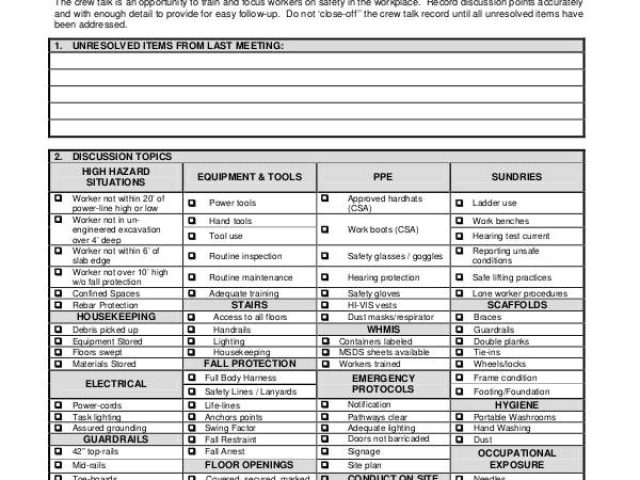
Below is a streamlined, professional-grade template you can print and use immediately. Copy the text into a Word or PDF document, customize as needed, and distribute.
TOOLBOX SAFETY TALK
Topic: ________________________ Date: _________________________ Time: _________________________ Location: ______________________
Presented By: _________________ Role: _________________________
- Attendees (Print Name & Sign):
- ___________________ __________
- ___________________ __________
- ___________________ __________
- ___________________ __________
- ___________________ __________
Key Hazards Identified: ☐ Slip/trip/fall ☐ Electrical ☐ Equipment operation ☐ Confined space ☐ Other: ______________________
PPE Required: ☐ Hard hat ☐ Safety glasses ☐ Gloves ☐ Hearing protection ☐ Respirator ☐ Fall protection ☐ Other: ______________________
Safety Controls in Place:
Discussion Notes:
Action Items: Item: _______________ By: ______ Due: _____ Item: _______________ By: ______ Due: _____
Template Version: 1.0 | Next Review: _______
Print multiple copies in advance. Keep one copy on-site and one in the office for records.
Top 5 Free Resources for Toolbox Talk Templates

While the template above works universally, you might want pre-made variations. Here are five reputable sources offering free, printable templates:
| Resource | Key Features | Best For |
|---|---|---|
| OSHA.gov | Official, compliance-aligned, minimal design | Government contractors, audit readiness |
| SafetyNow | Industry-specific topics (100+), editable PDFs | High-frequency users, diverse worksites |
| Creative Safety Supply | Visual-heavy, includes infographics | Teams with visual learners or multilingual staff |
| EHS Daily Advisor | Weekly updated topics, printable bundles | Companies wanting fresh content without effort |
| Safeopedia | Downloadable Word files, customizable fields | Teams integrating with internal safety systems |
All offer no-cost downloads without requiring an email—ideal for quick access in low-connectivity areas.
Making Toolbox Talks Stick: Beyond the Paper
A printable template is just the starting point. To see real behavioral change, integrate it into a broader safety rhythm.
Pair talks with daily safety walks. Use the template topics to guide your inspections. If the talk covered ladder safety, inspect all ladders on site that day.
Incorporate talks into onboarding. New hires complete a set of 10 core talks in their first week, signed and filed.
Use themed weeks. Focus on fall protection for one week, then lockout/tagout the next. The printable template becomes part of a larger safety campaign.
And don’t ignore near-miss reporting. If a worker narrowly avoids injury, reference the most recent talk. Did it address the hazard? If not, update your template library.
Final Thoughts: Safety Is a Habit, Not a Checkbox
A free printable toolbox talk template is more than a form—it’s a ritual. It forces daily attention on risk, fosters team accountability, and documents your commitment to workplace safety.
Download the template above, customize it for your crew, and use it consistently. Print it weekly. Sign it. File it. Repeat.
Because when an incident occurs, the question isn’t just “Was there a hazard?”—it’s “Did you talk about it?” With the right template, you’ll always have the answer ready.
FAQ
Where can I get a free printable toolbox talk template? You can use the customizable template provided in this article, or download from trusted sources like OSHA.gov, SafetyNow, or Creative Safety Supply.
Do toolbox talk templates need to be signed? Yes. Signatures confirm attendance and understanding, which is critical for compliance and liability protection.
How often should toolbox talks be held? Ideally daily or before high-risk tasks. Weekly at minimum, depending on project complexity and hazard level.
Can I use the same template for different industries? Yes, but customize the hazards and PPE sections to match your specific work environment.
Are digital toolbox talk forms as valid as printed ones? Yes, if they’re secure, timestamped, and include signatures. However, printed versions are often more practical on active job sites.
Should toolbox talk topics repeat? Yes, but with fresh context. Revisit core topics quarterly, aligning them with current site conditions.
What happens if I don’t document toolbox talks? You risk non-compliance with OSHA standards, reduced safety awareness, and weaker incident defense during investigations.
FAQ
What should you look for in Free Printable Toolbox Talk Template for Workplace Safety? Focus on relevance, practical value, and how well the solution matches real user intent.
Is Free Printable Toolbox Talk Template for Workplace Safety suitable for beginners? That depends on the workflow, but a clear step-by-step approach usually makes it easier to start.
How do you compare options around Free Printable Toolbox Talk Template for Workplace Safety? Compare features, trust signals, limitations, pricing, and ease of implementation.
What mistakes should you avoid? Avoid generic choices, weak validation, and decisions based only on marketing claims.
What is the next best step? Shortlist the most relevant options, validate them quickly, and refine from real-world results.