The Virginia Supreme Court is at the center of a constitutional showdown over a voter-approved congressional redistricting plan that appears to favor Democratic candidates. The court must now decide whether to uphold the map—ratified by citizens through ballot initiative—or strike it down on grounds that it violates state constitutional principles. This moment isn’t just about district lines; it’s about the balance of power between voters, courts, and political influence in shaping democracy.
The Origins of the Contested Map
In 2020, Virginia voters approved a constitutional amendment creating an independent redistricting commission tasked with drawing fair legislative and congressional boundaries. The intent was to end decades of partisan gerrymandering by removing map-drawing power from the state legislature. However, when the commission deadlocked in 2021, control defaulted to the Virginia Supreme Court, which appointed special masters to produce the final maps.
The resulting congressional map, while crafted under court supervision, has since drawn criticism for producing a 7–3 Democratic advantage in House seats—despite Virginia being a political swing state. Critics argue the map overrepresents Democratic strength, especially in suburban areas like Northern Virginia, where shifting demographics have altered political dynamics.
In 2023, a coalition of Republican voters and advocacy groups filed a lawsuit claiming the map violates the Virginia Constitution’s requirement for districts to be “contiguous, compact, and bounded by natural or artificial barriers.” They also argue it dilutes rural and conservative voting power, effectively locking Republicans out of fair representation.
Voter Approval vs. Judicial Oversight
What makes this case unique is that the map in question was validated by voters through a ballot measure supporting the redistricting outcome. This creates a rare tension: should a court overturn a map endorsed by the electorate, even if procedural flaws are alleged?
Supporters of the current map say the court’s intervention set a precedent. Since the commission failed to agree, the judiciary had both the authority and responsibility to produce a solution. The appointed special masters—a pair of nonpartisan experts—used demographic data, community input, and geographic coherence to craft districts. Their work was transparent, public, and ultimately accepted by voters when they ratified the broader redistricting framework.
Opponents counter that voter approval doesn’t override constitutional defects. They emphasize that the court’s role was to appoint mapmakers, not to immunize the final product from legal scrutiny. If the map violates compactness or splits too many localities, they argue, it must be corrected regardless of public endorsement.
This case tests a foundational principle: when voters ratify a potentially flawed process, does legitimacy outweigh technical compliance?
Compactness and the Fight Over “Fair” Districts
One of the central legal arguments revolves around the Virginia Constitution’s compactness requirement. The plaintiffs claim several districts, particularly the 5th and 7th, stretch across counties and cities in irregular shapes that disregard natural communities.
For example, Virginia’s 7th Congressional District snakes from Goochland County through parts of Richmond and extends into Louisa and Hanover. Critics say this creates a “daisy chain” of Democratic-leaning urban enclaves stitched together, bypassing more conservative rural areas. Similar concerns apply to the 5th District, which spans over 100 miles from Charlottesville to Danville, combining progressive college towns with struggling rural communities that don’t share economic or social interests.
Proponents respond that compactness must be balanced with other priorities: preserving communities of interest, complying with the Voting Rights Act, and reflecting population shifts. They note that Northern Virginia’s population boom necessitates redistricting that consolidates urban centers—even if the resulting shape isn’t perfectly geometric.
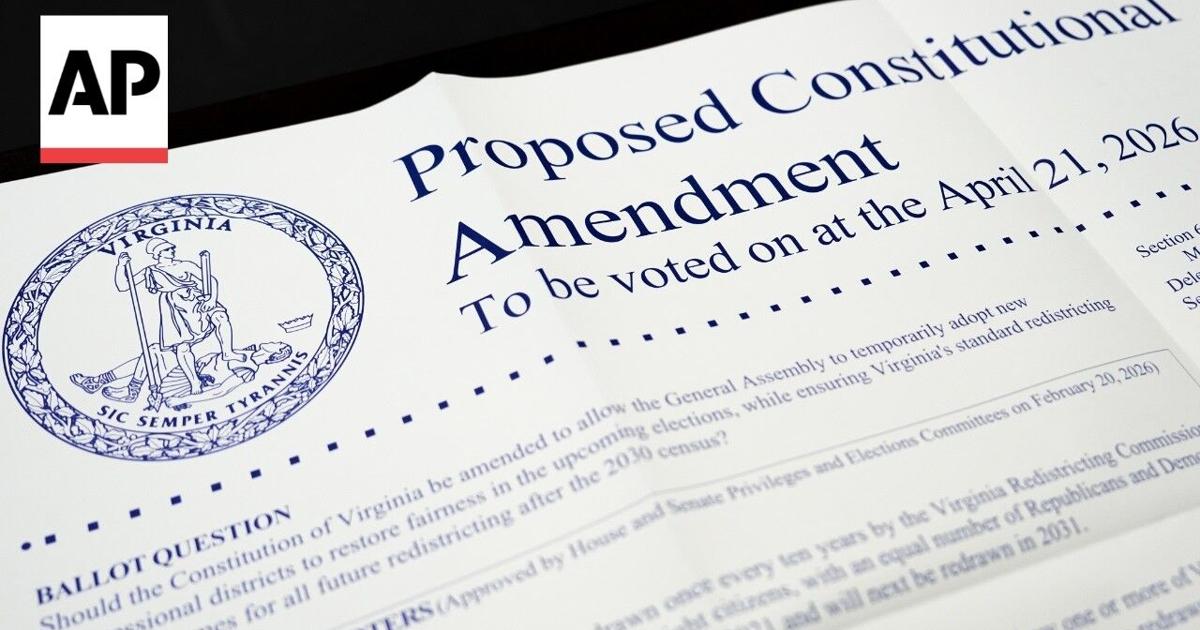
The court’s interpretation of “compact” could set a lasting standard. Will it adopt a strict geographic test, or allow flexibility for demographic and representational fairness?
Partisan Implications and Real-World Impact
There’s no denying the political stakes. Under the current map, Democrats won 7 of Virginia’s 11 U.S. House seats in the most recent election cycle. Before redistricting, the delegation was split 6–5 Republican. While national trends favored Democrats in 2022, analysts say the map amplified their advantage.
Take the 2nd District: once a swing seat, it now includes more of Norfolk and Hampton while stretching westward to cut into traditionally Republican areas of Virginia Beach. Incumbent Jen Kiggans, a Republican, won re-election by a narrow margin but now faces a redrawn electorate that leans bluer.
Similarly, the 4th District, anchored in Richmond and stretching southeast to Petersburg and Norfolk, has become a safe Democratic seat for Donald McEachin and now Jennifer McClellan. The consolidation of Black-majority populations—while arguably satisfying Voting Rights Act protections—has the effect of concentrating Democratic voters, which indirectly weakens their influence in adjacent districts.
This “bundling” effect raises ethical questions: is it fair to maximize minority representation at the cost of broader partisan balance? The court isn’t tasked with ensuring equal partisan outcomes, but it must consider whether the map systematically disadvantages one political bloc.
The Role of the Special Masters
The special masters—Professors Michael McDonald (University of Florida) and Bernard Grofman (UC Irvine)—were chosen for their nonpartisan expertise in redistricting and electoral systems. Their methodology emphasized data transparency, public hearings, and adherence to constitutional criteria.
They rejected partisan metrics like the Efficiency Gap or Predictive Partisanship Scores, focusing instead on population equality, minority representation, and municipal boundaries. Their final map split fewer counties and cities than previous iterations and preserved core communities like the Shenandoah Valley and Southside Virginia.
Yet their work is now under fire not for bias, but for outcome. Critics argue that even neutral mapmakers can produce skewed results if the demographic baseline is uneven. With over 70% of Virginia’s population concentrated in urban and suburban areas—most of which lean Democratic—any map respecting population equality will naturally favor Democrats.
This highlights a broader issue: as Americans cluster in cities, rural regions lose political influence. The court must decide whether this is an inevitable consequence of demographic change or a distortion requiring correction.
Precedent and the Court’s Delicate Balance
The Virginia Supreme Court’s decision could ripple far beyond state lines. State courts across the U.S. have increasingly stepped into redistricting disputes, especially after the U.S. Supreme Court’s 2019 ruling in Rucho v. Common Cause, which declared federal courts powerless to adjudicate partisan gerrymandering claims.
With federal restraint, state judiciaries have become the last line of defense against perceived map manipulation. Virginia’s case joins recent rulings in Ohio, North Carolina, and Pennsylvania where courts have tossed or reshaped maps over constitutional concerns.
But Virginia’s situation is distinct because of the voter ratification component. No other state has asked its highest court to invalidate a map that was indirectly endorsed by citizens through a constitutional process.
If the court strikes down the map, it risks appearing antidemocratic—overruling the will of the people. If it upholds the map despite compactness concerns, it may set a precedent that weakens constitutional safeguards.
Legal scholars suggest the justices may seek a middle path: ordering minor adjustments rather than a full redo. This would acknowledge procedural flaws without triggering chaos ahead of an election cycle.
What Happens Next?
The court’s ruling is expected within months. If it blocks the current map, the legislature could be forced to redraw boundaries, or the court might reappoint special masters for a revised plan. Either way, the clock is ticking toward the next election, and uncertainty could destabilize candidate planning and voter outreach.
Candidates already running under the current districts may face last-minute changes. Parties would need to reassess campaign strategies, fundraising targets, and field operations. Voter confusion could spike if polling places shift or district identities dissolve.
A ruling against the map might also reignite political debate over the independence of redistricting commissions. Reformers could argue that the court’s involvement—first in appointing mapmakers, then in reviewing their work—undermines the goal of removing politics from the process.
Conversely, a decision to uphold the map would affirm that voter input and demographic reality can outweigh strict geometric standards.
A Test of Democracy and Law
This case isn’t just about lines on a map. It’s about who gets to draw them and whose voice ultimately counts. The Virginia Supreme Court must weigh constitutional fidelity against democratic legitimacy, technical rules against real-world representation.
There are no clean answers. Compactness matters, but so does reflecting how people actually live and vote. Partisan balance is elusive in a polarized era, but fairness shouldn’t be sacrificed to demographic inevitability.
The court’s decision will echo through future elections, shaping not only Virginia’s congressional delegation but also the nation’s understanding of what fair representation means in the 21st century.
Lawmakers, advocates, and voters should prepare for either outcome. If the map stands, efforts should focus on civic education to help voters understand new district boundaries. If it falls, stakeholders must push for a transparent, inclusive redrawing process—without reverting to old partisan games.
One thing is clear: the fight over Virginia’s House map is a microcosm of America’s broader struggle to balance equity, law, and democracy in an era of rapid change.
FAQ
Could the U.S. Supreme Court get involved in this case? Possibly, but unlikely. The U.S. Supreme Court has ruled it won’t intervene in cases of partisan gerrymandering under federal law. Only if a federal constitutional issue—like Voting Rights Act violations—is raised would federal review be probable.
Does the Virginia Constitution ban partisan gerrymandering? Not explicitly. While it requires districts to be contiguous and compact, it doesn’t mention partisanship. However, recent amendments emphasize “nonpartisanship” in redistricting goals, giving courts some basis to consider political fairness.
How many counties were split by the current map? The current congressional map splits 11 of Virginia’s 95 counties and several independent cities. Critics argue this violates the principle of keeping political subdivisions intact.
What happens if the court blocks the map? The court could order a new map be drawn—either by a reconstituted commission, the legislature, or newly appointed special masters. Interim solutions might be used for upcoming elections.
Did the special masters consider partisan data? They had access to it but stated they did not use partisan voter registration or election results as inputs. Their focus was on geography, population, and demographic fairness.
Can voters challenge the court’s decision? Not directly. The Virginia Supreme Court is the final arbiter of state constitutional matters. Only a constitutional amendment or new legislation could override its ruling.
Has Virginia ever had court-drawn maps before? Yes. In the 1960s and 1970s, federal courts intervened to correct malapportionment. More recently, state courts oversaw legislative maps in the 2010s due to gerrymandering rulings.
FAQ
What should you look for in Virginia Supreme Court Weighs Fate of Democrat-Favored House Map? Focus on relevance, practical value, and how well the solution matches real user intent.
Is Virginia Supreme Court Weighs Fate of Democrat-Favored House Map suitable for beginners? That depends on the workflow, but a clear step-by-step approach usually makes it easier to start.
How do you compare options around Virginia Supreme Court Weighs Fate of Democrat-Favored House Map? Compare features, trust signals, limitations, pricing, and ease of implementation.
What mistakes should you avoid? Avoid generic choices, weak validation, and decisions based only on marketing claims.
What is the next best step? Shortlist the most relevant options, validate them quickly, and refine from real-world results.